.avif)


“What happens if you can?”
The night Maria finally rang Clean Slate, she’d already spent several nights crying in her husband’s arms, asking him the same question: what happens if I genuinely can’t do this? She wasn’t being dramatic. She’d tried to get help before. She’d been handed coping tools and sent back into her life and watched herself fall apart anyway, and somewhere in the years that followed she’d stopped believing that anyone could actually help her.
Her husband had sat with her through all of it. Every time she asked, what happens if I can’t, he’d said the same thing. You can. This time she pressed harder: ‘What if I try this and it doesn’t work, and there’s nothing left to try?’
“What happens if you can & it’s better than you could ever imagine?” he said.
She booked the appointment.
24/7
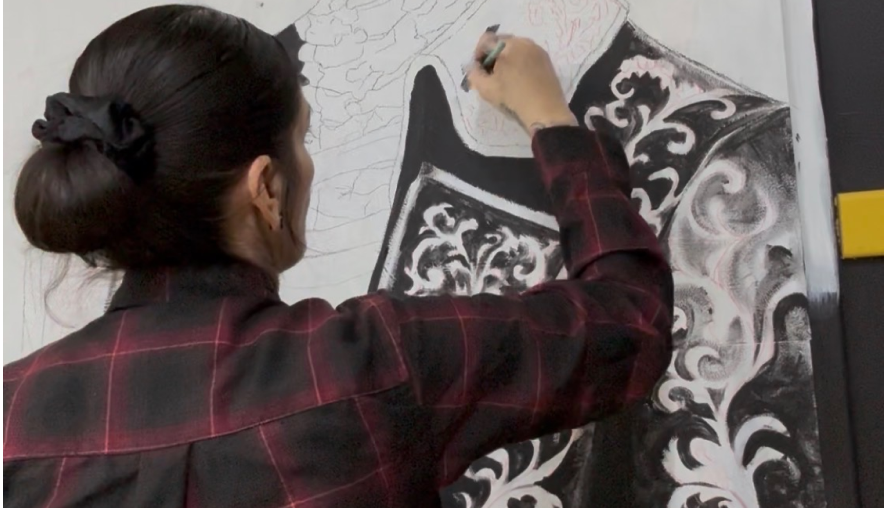
Maria is in her 40’s and has worked as a tattoo artist for twelve years, now running her own studio. Her friends would describe her as giving, passionate and loyal - the kind of person who shows up. But for most of her adult life, she hadn’t been able to see any of that in herself.
Her drinking had started the way it does for most people - barbecues, events, nothing alarming. Then came a series of traumatic events, and alcohol shifted from something social into something functional: a way to get through the day, then through the night, then through the morning before the bottle shop opened - because without it she’d be shaking before she could do anything.
“There was no day-to-day,” she says. “It was just drinking 24/7.”
She kept the worst of it from almost everyone. Two close friends knew. Her parents didn’t understand the extent of it. The only person who really saw what was happening was her husband, who’d been holding her hand through it from the beginning - and even from him, she managed the distance as best she could, because she didn’t want to let anyone down, and keeping it contained felt like the only way she knew how.
Beer
Maria’s wake-up calls didn’t arrive as one dramatic moment. They arrived as two quiet ones, both involving her eight-year-old daughter, and together they were enough.
The first was a school worksheet - one of those Mother’s Day exercises where kids write down their parents’ favourite things. Two years in a row, her daughter was asked what mum’s favourite drink was. Two years in a row, she wrote the same answer.
Beer.
“She’s too young to even know what that is, let alone be writing it at school,” Maria says. “And these teachers are seeing this.”
The second was harder to name, but more frightening. Maria is a visual person - an artist who has always thought in images, who can picture things before they exist. She tried to picture her daughter at fifteen, at twenty-five, on her wedding day. Nothing came. The image wouldn’t form.
“I couldn’t picture who she was going to be. And I’m such a visual person - I couldn’t see anything going past maybe the next six months. That was telling me I’m just dying. I’m killing myself.”
That made her reframe things into one, binary question: do I want to see my daughter walk down the aisle, or do I want to die? “If I answer I want to die - hurry up and get it over with. And if not, put your ass into gear and change it now.”
Coming back to it all
Three years before Clean Slate, Maria had tried a residential rehab. They took her to a farm, away from everything, and she understood the logic - the idea that distance might let you see your life differently. But when she came home, her life was exactly where she’d left it. The same triggers and the same environment, with no follow-up. The coping tools had nowhere to land.
“They tried to heal me out there,” she says. “But when you come back, reality is still there.”
She fell straight back into drinking, and alongside that came something harder to recover from than the drinking itself: she’d stopped believing that anyone could help her. By the time her husband found Clean Slate, she’d largely given up on the idea. She tried it anyway - more out of exhaustion than anything resembling hope.
What shifted the decision before a single appointment had happened, was knowing she could do the programme from home, alongside her husband and daughter.
“Knowing I could get this support from home, with my husband and daughter by my side - that’s what gave me the push.”
Not just another number
The thing that surprised Maria most about Clean Slate wasn’t any particular tool or resource - it was the personalised approach.
“Clean Slate was accepting of my individual story. Everyone comes from somewhere, and the same ‘rules’ for recovery won’t work for everyone. I liked that flexible approach, compared to the idea of everyone walking the exact same path.”
Maria had always isolated herself when things got hard, so the idea of group meetings felt confronting enough that she nearly talked herself out of them. She decided to show up anyway. The peer-support group meetings became one of the most important parts of her recovery. It was the place where she did the real unpacking, and learned a style of journaling that became how she expressed the things she couldn’t say out loud. Not the dear-diary kind, but simple dot points to break things down small enough to hold.
“I would think, ‘I’m not just going to let myself down - I’d be letting our little community down’,” she says. “I have to show up.”
Her nurse appointments ran alongside all of this as steadier check-ins. “I could feel the warmth,” Maria says. “I felt safe.”
Big girl pants
Somewhere around the six-month mark, Maria realised she was working on something she’d never had the time or the space to work on before. She’d had her son at 17 - and before that, she’d barely had a childhood. Her whole adult life had been organised around showing up for someone else - and while that was genuinely who she was, there had never been a version of herself that existed outside of it. The void underneath wasn’t something she’d named. It had just been there her whole life, underneath everything.
“I felt like I never had control of my life. I didn’t have my own identity. And now I do.”
Her art had been there for twelve years, but she’d been working in environments that weren’t right for her - and weren’t the kind of environment she wanted for her daughter, who was already showing her own creative gifts. Maria didn’t want her growing up thinking the only way to do art was to work for someone who controlled the conditions. So she made a plan: get sober, put her big girl pants on and get her own studio.
She ticked off every single item.
Meeting Brody
Soon after Maria’s studio opened, a young man named Brody walked in with a request to place a ‘Containers for Change’ bin out the front of her shop. He was planning to collect enough cans, to save enough money, to ultimately build his own small business selling dog treats. He just needed somewhere to put the bin.
“That’s ballsy,” Maria says. “It’s really ballsy of him to walk into a tattoo studio and just ask.”
She said yes, and then found herself wanting to help more. She started assisting with packaging, design labels, recruiting other businesses in the area - you name it.
And one day while she was deep in helping Brody, Maria sat back and did the maths on what she was looking at.
“A good twelve months ago, I could have helped him fill up two or three wheelie bins with the amount I was drinking. And now I’m helping collect them for him,” she pauses. “I’m just so proud of that turnaround.”
“She’s not a bad chick”
Maria’s husband had never known her sober. She met him while she was in the middle of a challenging period, and pushed him away for a long time because she didn’t want to bring her chaos into someone else’s life. He stayed, held her hand through all of it, and kept believing something she couldn’t yet access herself. He calls her the strongest woman he’s ever met, and it’s taken her a while to stop arguing with that.
Her eldest son didn’t know she was doing the Clean Slate programme. She’d made a deliberate decision not to tell him because she knew he’d be sceptical. She wanted him to see it first - and when he did, his whole demeanour changed.
“We have a fantastic relationship now,” Maria says. “He’s asking me for advice about his own life now, knowing I’m actually there in a way I wasn’t before. I’m present.”
And Maria, for the first time in her life, is genuinely surprised by who she’s turned out to be.
“I didn’t know who I was,” Maria says. “It felt like such a void. And now I can honestly say - she’s not a bad chick. She’s a pretty cool chick.”
What if you can?
When Maria thinks about what she’d say to someone who’s scared of what life might look like without alcohol, she doesn’t reach for comfort. “Think about how your life’s going to continue if you keep drinking. Think about it for the next twenty years - you might not even live that long.”
And then she offers the other side of it - the question her husband asked her.
“What if you can achieve this? What if you can achieve your dreams - what does that look like? That’s bloody exciting. It’s a massive opportunity to gain control of your life and actually appreciate it.”
For someone who spent decades not knowing who she was, the answer turned out to be more than she’d let herself imagine. A studio. A community built around helping others. A son who calls because he wants to, not because he feels he has to. A daughter whose memories of her mother have nothing to do with beer.
“You’re not alone,” Maria says. “You already feel like you’re at rock bottom - so you may as well give it a go. You’ve got nothing to lose.”
If this story brings up difficult feelings for you, or if you or someone you know is struggling, support is available. Please contact Samaritans on 116 123 (24/7) or visit samaritans.org.
.svg)





Ready to get started?







%20(1)%20(1)%201%20(1).png)